Advertising on ChatGPT doesn't put you in the answer. It puts you below it.
 By Miguel Maio ·

TL;DR
- OpenAI opened ads inside ChatGPT — in Europe, self-serve, and still in Beta.
- You buy a labelled slot below the answer (CPC or CPM), not a place inside it.
- The campaign lives on a system separate from the model: by principle and by design, the answer isn't for sale.
- Confuse the two worlds and you pay for clicks in a young auction while staying invisible where the decision is made.
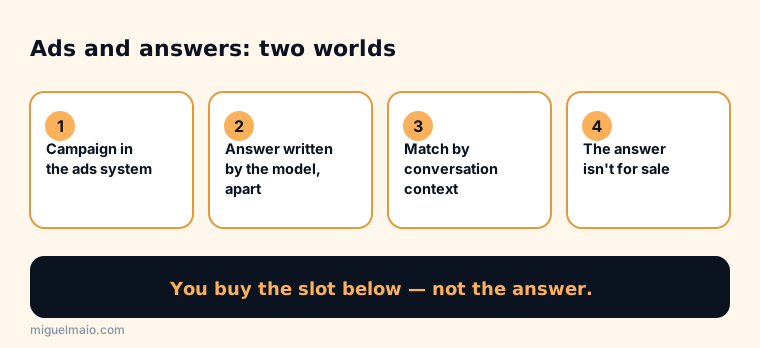
For years, OpenAI resisted putting advertising inside ChatGPT. It stopped resisting. And the question almost everyone asks — "can I finally pay to appear in ChatGPT?" — is the wrong one. You can pay to appear below the answer, in a slot marked as sponsored. You can't pay to be the brand the model names inside the answer. They are two worlds, on separate systems, and the separation is literal — it's in the technical design, not just the messaging.
What OpenAI announced — and what's live in Europe
Ads in ChatGPT went live on 9 February 2026, with a US pilot for logged-in adult users on the Free and Go plans. Paid plans — Plus, Pro, Business, Enterprise and Education — have no ads. The rollout was phased: Canada, Australia and New Zealand in March; the UK, Mexico, Brazil, Japan and South Korea in August.
For anyone working the European market, the August 2026 dates matter: on the 18th, OpenAI brought ChatGPT Ads to 31 European markets; on the 31st, it opened self-serve access through Ads Manager across Europe, the Middle East and North Africa, and announced $1 billion in annualised revenue in under 200 days, with ChatGPT serving more than a billion weekly active users. This stopped being a lab experiment: it's a channel with real money flowing in and an auction forming.
An honesty caveat: the outcome examples OpenAI publishes (an ecommerce advertiser with 3x return on ad spend over 28 days; a partner reporting more than 80% new customers in ad-driven traffic) are isolated cases OpenAI chose, not market averages. A signal, not a benchmark.
Why they're two worlds — and what that means for the campaign
The campaign and the answer run on different systems, and this isn't rhetoric. Your entire campaign — targeting, bidding, creative, audiences — lives in the ads world. OpenAI's ads system decides delivery by matching your ad against the context and intent of the current conversation and your targeting selections. The model that writes the answer, by default, doesn't even know the ad exists — ChatGPT can't see the ads shown to you, unless you share one with it.
This is where the rest of the article comes from. Because the campaign has no wire into the answer generator, there's no button to buy the answer — there's only the auction for the slot below. An advertiser can't shape, rank or alter what ChatGPT answers, and seeing an ad isn't an OpenAI endorsement. What OpenAI calls "answer independence" is, in practice, a wall of architecture between the two worlds.
Where the ad appears — and where it never does
The ad shows up below the end of a response, always labelled as sponsored and visually separated from the text. It's not a link mid-paragraph: it's a separate block, at the end, with one or more units, when there's a match with what you're discussing. The launch format is the product card — image, title, price, one detail — and OpenAI already supports product feeds, with more formats promised.
Where it doesn't appear is just as strategic: no ads in temporary chats, in the ChatGPT Atlas browser during the test, or in accounts of under-18s. Nor near sensitive or regulated topics — personal health, mental health, politics. That defines the contexts in which your brand can be shown at all.
How you buy: self-serve, partners and agencies
There are three doors in, and which one you use depends on size and structure. The first is the self-serve Ads Manager (ads.openai.com), opened in Europe on 31 August — you register as an advertiser, add payment, set budgets, bids and pacing, upload ads and manage everything in the portal. The second is the agency partners OpenAI works with directly — Dentsu, Omnicom, Publicis, WPP. The third is the technology and measurement partners — Adobe, Criteo, Kargo, Pacvue, StackAdapt, among more than 50. In every case, one rule holds: OpenAI's system controls all delivery decisions.
On the auction, it started with CPM, gained CPC in May (you pay per click — fitting for an interface where the conversation is active and decision-oriented) and evolved into conversion optimisation, already the majority of campaigns. CPM and CPC remain available.
That's what the announcements say. I went to see what's actually there — I opened the Ads Manager from Portugal:
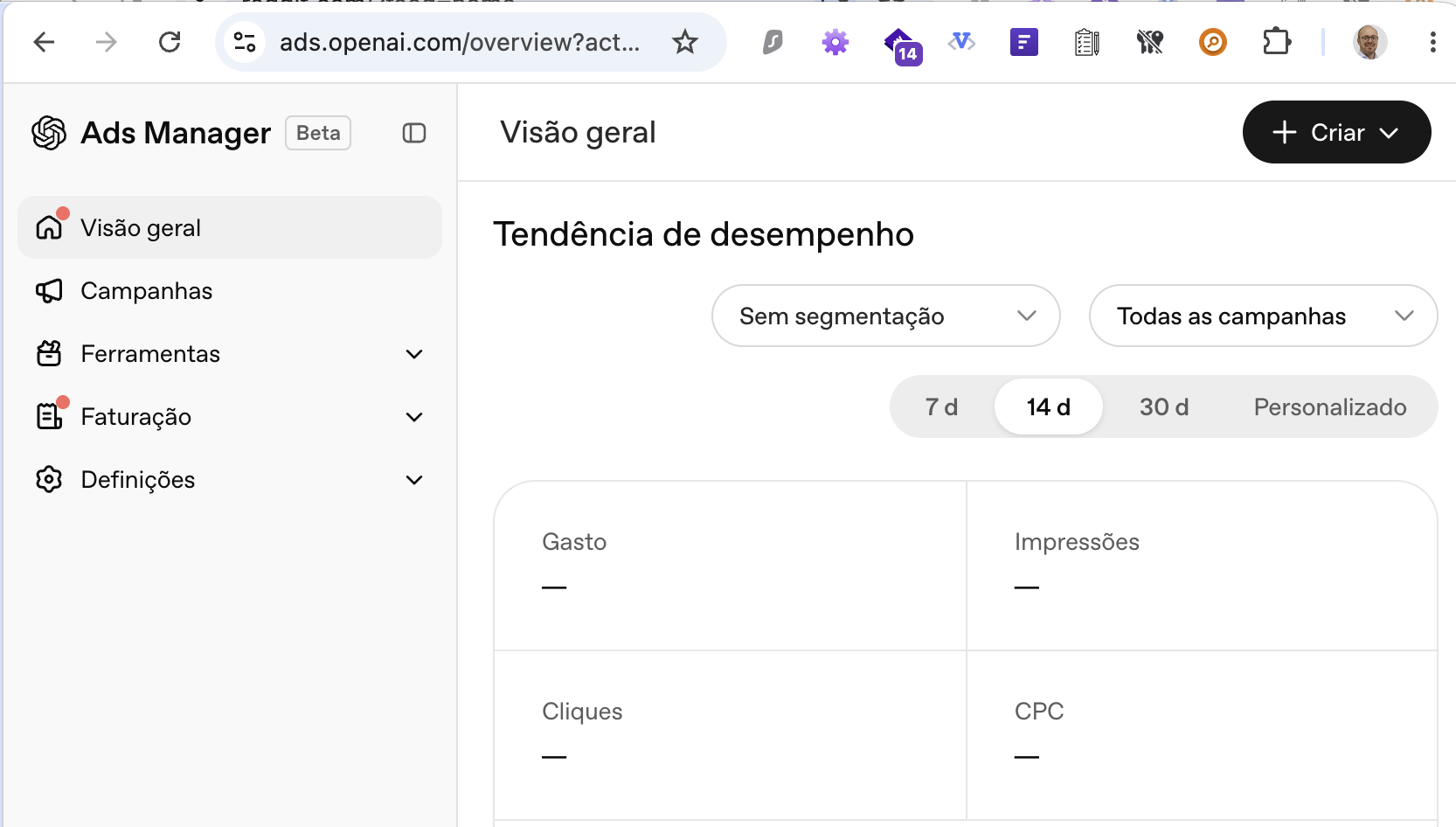
Three things the screenshot proves, worth more than any press release. First: it's live and self-serve in Europe — not a "coming soon". Second: it's marked Beta, and it shows — the spine is that of any ad manager (Campaigns, Tools, Billing, Settings, the Create button, 7/14/30-day windows), but stripped down. Third, the most revealing for anyone who runs paid: the metric the platform puts on the landing dashboard is CPC. Anyone who has run digital advertising since 2007 reads that in a second — it's a cost-per-click auction in a conversational coat. The logic is familiar; what isn't here yet (history, auction benchmarks, the twenty years of measurement maturity behind Google Ads) also shows. It's a beginning, not a Google Ads.
Targeting and audiences
By default, targeting is contextual: the ad responds to the topic and intent of the current conversation, with basic context like language and general location. On top of that, there's geo-targeting and platform targeting. And there are custom audiences, which is where it gets serious if you have your own data.
You build a custom audience in Tools → Audiences → Create, with a CSV or TXT file (UTF-8, up to 500 MB) of identifiers: email, phone in E.164 format, SHA-256 hashed email or phone, or Google Advertising ID. Once processed (about 20-30 minutes), it's used three ways: inclusion (the campaign is only eligible for people in the audience), exclusion (blocks delivery to people in it — current customers, recent buyers) and ad-group bid multipliers (from 0.1x to 10x, to bid more for high-value customers). Two thresholds to remember: inclusion and bid adjustments need at least 25,000 matched users (OpenAI recommends 100,000); exclusion works at any size. It's all audience-level — Ads Manager never shows or lets you pick individual people. And the files you upload are normally deleted within 24 hours of processing.
Measuring: the Pixel and the Conversions API — and why
A click is a poor signal when the goal is a purchase or a lead. So OpenAI launched pixel-based measurement and a Conversions API: they exist to see what happens after the click — purchase, sign-up, contact request — not just the click itself. Without that conversion signal, CPC misleads and conversion optimisation has nothing to aim at; with it, you can ask the platform to optimise for the outcome that matters, not for impressions.
The model is that of any serious conversion measurement: the pixel fires on your site when the event happens, or you send the event server-side through the Conversions API so you don't depend only on the browser. The difference from the classic world is privacy by design — you get aggregated performance insights, never conversations or individual data. That's the entry price for honest conversion optimisation: instrument your site, don't expect the click to tell the whole story. Without measurement, this is faith; with measurement, it's management.
Managing at scale: web, bulk and API — and the Ads Editor question
There's no desktop app like Google Ads Editor. Management is in the browser, in Ads Manager. For volume, you have two routes: bulk upload of a file inside the interface (there's a schema checklist to validate before uploading) and a Bulk API that creates or updates campaigns, ad groups and ads in a single async job — up to 1,000 operations at a time. The catch: the Bulk API (and the Advertiser API in general) is in limited preview, provisioned only to approved accounts and partners. It's not a public endpoint you open this afternoon.
This also answers the question about managing campaigns with AI. There is an Advertiser API to create and manage campaigns programmatically — and on top of it you can build automation, including agents that adjust bids or pause campaigns by rules. But it's a build-it-yourself, and only if you're an approved partner. There is, to date, no native product where you tell ChatGPT "manage my campaigns" and it does. What's native and automatic is on OpenAI's side: its delivery system decides, on each response, which ad to show. Your AI can prepare feeds, creatives and rules; the delivery decision isn't yours.
The legal frame — and I'm not a lawyer
This is orientation, not legal advice: for decisions, confirm with someone who can give it. That said, there are three fronts an agency in Europe has to keep an eye on.
GDPR, on two levels. OpenAI designed the ads with a distinction that matters: contextual ads (only the current conversation, approximate location, device type, time, language) run under legitimate interest and don't ask for consent; personalised ads (history, memories) require explicit opt-in and are off by default in the EEA and Switzerland. Practical consequence for the European user: declining personalisation changes which ads you see, not whether you see ads.
Digital Services Act. Several press outlets report that the European Commission designated ChatGPT as a very large platform under the DSA (based on about 159 million monthly EU users), which would bring heavier obligations — risk assessments, independent audits, a public ad repository and data-sharing with regulators. I treat this as press-reported, not confirmed by OpenAI; but it's the regulatory piece to watch.
AI Act. Article 50 requires generative AI systems to disclose their AI nature to users, and enforcement powers became active in August 2026. The labelled ad format helps on that transparency dimension. Add the obvious: misleading advertising is still banned, regulated categories have strict criteria, and there's no political advertising in ChatGPT for now.
What this changes for your brand
If you sell product and have a feed, there's a new channel to test here while the auction is young and CPC hasn't been bid to the bone. Test small, with the Pixel installed and a clear conversion hypothesis, and don't move budget from what already works because of a Beta. Basic paid management — it applies just the same here.
The strategic mistake, though, isn't budgetary — it's conceptual. It's treating OpenAI Ads as "the new place to appear in ChatGPT" and stopping there. Because most of the times your brand shows up in an answer, it won't be in an ad: it'll be — or not — in the answer itself, and that part has no auction, it has authority. Whoever invests only in the sponsored slot and ignores the answer will pay for clicks today to discover, a year from now, that a competitor owns the category in the one place with no ads: inside the text the model writes. The two worlds coexist. Only one of them compounds.
Sources
- OpenAI — Testing ads in ChatGPT
- OpenAI — New ways to buy ChatGPT ads
- OpenAI — ChatGPT Ads expands across Europe
- OpenAI — A milestone in expanding access to AI (1B run rate)
- OpenAI Help Center — Ads in ChatGPT
- OpenAI Help Center — Set up Custom Audiences
- OpenAI Developers — Ads API overview and Bulk API
- OpenAI Ads Manager
Frequently asked questions
Can I advertise on ChatGPT from Europe?
Yes. Self-serve access through Ads Manager opened in Europe on 31 August 2026, with the interface localised (still Beta). Check availability and terms at ads.openai.com. Advertising in AI search →
How much does it cost?
You buy by CPC or CPM, with conversion optimisation available. The real cost depends on the auction and competition in your category, which is still forming. There's no rate card.
Can I manage it with an app like Google Ads Editor?
No. Management is in the browser (Ads Manager); for volume there's bulk file upload in the interface and a Bulk API (up to 1,000 operations), but the latter is in limited preview, for approved partners only.
Can I manage campaigns with AI or an API?
There is an Advertiser API to create and manage campaigns programmatically, on top of which you can build automation — but it's provisioned to approved partners only. The delivery decision is always OpenAI's system.
How do audiences work?
Contextual by default; you can add geo and platform, plus custom audiences by upload (email, phone, hash or GAID). Inclusion needs 25,000 matched (100,000 recommended), exclusion any size, and there are bid multipliers from 0.1x to 10x. All audience-level, never individual people.
Do ads influence ChatGPT's answers?
According to OpenAI, no: they run on systems separate from the model and you can't pay to be recommended. A stated, verifiable principle today; worth continuing to watch. What GEO is →
In Europe, do ads use my history?
By default no. Personalisation from past chats and memories is off by default in the EEA and Switzerland — ads are contextual to what you ask in the moment.