Why SEO is important: the top mistakes brands make in 2026
 By Miguel Maio ·

TL;DR
- The reasons SEO projects fail are almost never tactical (keywords, titles) - they're platform, organisation and measurement. I've been through all of them, agency-side and client-side.
- The costliest and least-discussed: framework decisions (client-side React/Angular/Vue) that make the site invisible to AI, migrations with no redirects, infrastructure blocking crawlers, and broken attribution that makes organic look like it doesn't convert.
- The thesis: a brand that can't implement SEO will fail the move to GEO. The foundations are the same - and GEO is less forgiving: no second position, opaque feedback, and you can't buy your way in.
- What separates those who make it isn't knowing more SEO. It's being able to execute, having an owner for organic, and measuring the right thing.
SEO has never mattered more than in 2026 - and not for vanity rankings: it's the foundation both Google search and LLM citation depend on. That's why the mistakes cost so much. After more than two decades, agency-side and client-side, I've learned an uncomfortable thing about SEO projects that fail: they almost never fail because of SEO. It's not the wrong keyword or the badly written title. It's a platform decision made in a meeting SEO wasn't in, an org chart where organic belongs to no one, or an Analytics setup that makes the channel look useless. And those exact causes now decide who survives the move to GEO.
The usual suspects - impatience, thin budget, poor communication - exist and are real. But they're written up everywhere and are rarely what actually kills the project. What kills it sits deeper, and that's what I'll list here, by family. I've seen all of them from the inside.
Family 1: technical execution and platform
This is where projects die earliest and most invisibly, because the decision is made by engineering before marketing understands what happened.
The framework that makes you invisible to AI. A client-side React, Angular or Vue SPA hands the bot an empty screen and injects the content with JavaScript afterwards. Googlebot still renders, in a second wave and on a delay - so the site even ranks. But AI crawlers don't execute JavaScript: in the Vercel/MERJ study, GPTBot fetches JS files in about 11.5% of requests and never runs them, ClaudeBot downloads them in about 23.84% and also doesn't execute them, and none of the major ones render. The result: the same site can be in Google and completely invisible in ChatGPT, Claude and Perplexity, which only saw the loading state. The honest test isn't DevTools, it's "view source": if the text isn't there, AI can't read it. And the worst part follows - the same architecture decision makes engineering answer "not possible" to schema, redirects or hreflang, blocking everything else at once.
Migrations and redesigns with SEO called in at the end. When the site changes platform, domain or URL structure without a 1:1 redirect map ready before launch, the history evaporates. Organic traffic drops of 30% to 50% are common when SEO wasn't at the table from the start - and recovering them costs months.
Infrastructure blocking who should get in. CDN, WAF and bot-management (Cloudflare, Akamai) flagging Googlebot or GPTBot as a threat and serving them a 429 or a JavaScript "prove you're human" challenge; cookie walls and consent platforms (CMP) hiding content behind a click the bot won't make. These are security and privacy decisions, made far from marketing, that cut off access with nobody noticing.
A link architecture bots can't follow. Internal links built only in JavaScript (an onclick, a button, a div) that crawlers don't follow - Google is explicit that it only crawls <a href> - and faceted navigation that spawns millions of parameter URLs, burning crawl budget and diluting indexing.
Family 2: organisation and decision
This is the hardest family to fix, because it isn't fixed with code - it's fixed with people and with power.
Low digital-marketing literacy among the deciders. Not the client in general - the PMs, POs and stakeholders who control the roadmap. They prioritise by measurable feature impact, and organic - slow, cumulative, hard to attribute - always loses the sprint. In product-led organisations organic belongs to no one: it falls between marketing and engineering. And by a kind of Conway's law, the org structure ends up mirrored in the HTML itself.
Recommendations that never get implemented - and the conflict nobody admits. The consultant defines, but the internal team or the site vendor executes, and they deprioritise what they consider "minor". And there's a more delicate layer, visible only from inside: external recommendations create conflicts of interest. The internal team may read them as criticism of their work, and a site vendor may feel them as someone exposing their decisions in a way that threatens their role or their contract. The outcome isn't technical, it's political: the right recommendation stays in the drawer because implementing it would mean admitting someone else's mistake.
Compliance, legal and brand guidelines shaping the content. In regulated sectors, legal review cycles and mandatory disclaimers and boilerplate don't just slow content down - they manufacture exactly the thin, templated, duplicate content that both Google's scale signals and LLM retrieval deprioritise. Badly managed compliance doesn't stall the content strategy: it produces the kind of content that's born to fail.
Family 3: economics and measurement
This is the family that gets good projects cancelled for looking bad.
Broken attribution - or none at all. With no attribution model, or a last-click one that hands all the credit to the final touch, organic shows up feeding conversions another channel banks, and budget migrates to paid because it's "attributable". In the worst cases the problem predates the model: bad Analytics installs - GA4 with no conversion events, consent mode denying by default, duplicated or misfiring tags - that not only prevent correct attribution but even lose the traffic's own source, pushing organic visits into "direct" or "not set". The channel didn't fail; the measurement never let it prove its value.
Misaligned agency incentives. When you pay for deliverables and hours instead of results, the report factory is born - lots of activity, little revenue. And on the buying side, procurement picking the cheapest, or whoever promises rankings, guarantees failure before the project starts.
The counter-argument, in its strongest form
The honest objection to all this is: "GEO is new, you start from scratch, the SEO history doesn't count - a brand that failed at SEO can get GEO right with a clean restart." It's the strongest version of the opposing case, and it deserves a serious answer, not a straw man. The true part is that tactics change and there's room for newcomers. The false part is believing that what failed was tactics. What failed was the capacity to execute, to decide and to measure - and that doesn't reset with a new technology.
The bridge: who can't implement SEO fails GEO
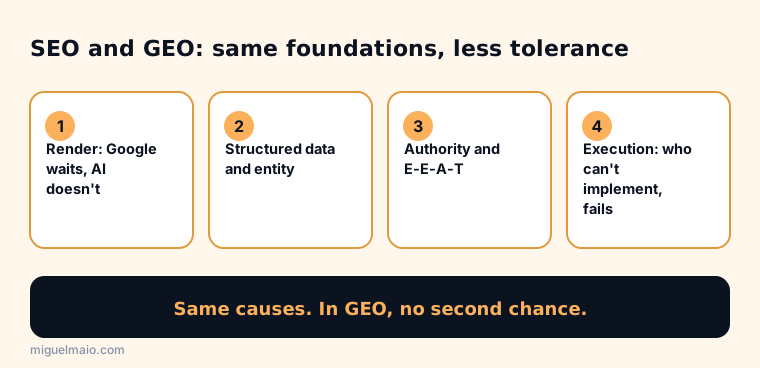
Visibility in LLMs rests on the same foundations as SEO: crawlability, content the machine reads without JavaScript, structured data and a clear entity, authority and E-E-A-T, and - the one that decides everything - organisational capacity to execute. An agency reading (to be cited as such, not as settled fact) illustrates the gap: Fuel estimates that 94% of brands invest in traditional SEO but 62% are "technically invisible" to AI, and that in 81% of unbranded questions the models don't cite them; valid Organization schema is associated with 3.5x higher odds of being cited by ChatGPT.
And GEO is less forgiving than SEO on three counts. There's no second position: in a generated answer there are no ten results and no second page - either you're the source or you don't exist. The feedback is opaque and slow: there's no "ranking" to watch climb as you fix things. And you can't buy your way in: there's no auction to offset a weak foundation. That's why the client-side rendering decision that was merely a delay in SEO - Google eventually rendered - is a sentence in GEO: AI never sees it. The inability to implement isn't a risk running parallel to GEO; it's the same risk, amplified.
What separates those who make it from those who don't
It isn't knowing more SEO. After watching these failures repeat, what I ask before taking on a project is simple and uncomfortable: a single owner for organic with real power, access to the data (GSC, GA4, logs) from day one, and a commitment that the critical recommendations - the ones touching render, redirects and bot access - are treated as bug fixes, not optional enhancements. I handle measurement before content: an Analytics install that loses the traffic's source makes everything else indefensible. And I frame recommendations to defuse the conflict of interest - as a shared problem, not an accusation. Those who have this move from SEO to GEO without drama. Those who don't will fail both, and GEO first.
The question that decides isn't "are we ready for GEO?". It's "are we able to implement what our own SEO already told us to do?". If the honest answer is no, GEO isn't the next opportunity - it's the next place the same problem will cost more.
Key data
| GPTBot: fetches JS but doesn't run it | ~11.5% of requests |
|---|---|
| ClaudeBot: downloads JS, doesn't execute | ~23.84% |
| Brands not cited on unbranded queries | 81% (Fuel est.) |
| Organization schema and ChatGPT citation | 3.5x more likely |
Third-party data (Vercel/MERJ; Fuel, agency); vary by method. Read the order of magnitude.
Sources: Vercel / MERJ - The Rise of the AI Crawler · Fuel - 2026 State of Generative Search
Sources
- Vercel / MERJ - The Rise of the AI Crawler (AI crawlers don't render JavaScript)
- Google Search Central - Make your links crawlable
- Search Engine Journal - recovering traffic drops from a migration
- Fuel - 2026 State of Generative Search (agency data)
Frequently asked questions
My React site ranks in Google. Why should I worry?
Because Google renders JavaScript in a second wave and AI doesn't. Per the Vercel/MERJ study, AI crawlers don't execute JS - your site can be in Google and invisible in ChatGPT, Claude and Perplexity. Check "view source": if the content isn't there, AI can't see it. SEO vs GEO →
If I can't change the framework, what do I do?
You don't need to rewrite everything. Server-side rendering, static generation (SSG) or pre-rendering (dynamic rendering) hand ready HTML to bots that don't render. It's an architecture decision, and one of the highest-return ones right now. Technical SEO checklist →
I inherited all these problems at once. Where do I start?
With measurement, not content. First make sure Analytics doesn't lose the traffic's source, or you can't prove anything. Then access and render. Only then content and entity. Measure AI traffic →