Lead generation: the mistakes that kill profit

Lead generation doesn't create demand: it accelerates what's already there. A weak product, the wrong segment or an inflated promise scale in the same proportion. I turn down nine out of ten brands that come to me for this, not on price, but because there's no way to measure or control what happens to the lead after I hand it over. Paid per lead with no control of the chain is the worst seat for whoever generates: you carry the risk, the advertiser keeps the upside. And without end-to-end measurement there are no conversions, there's faith.
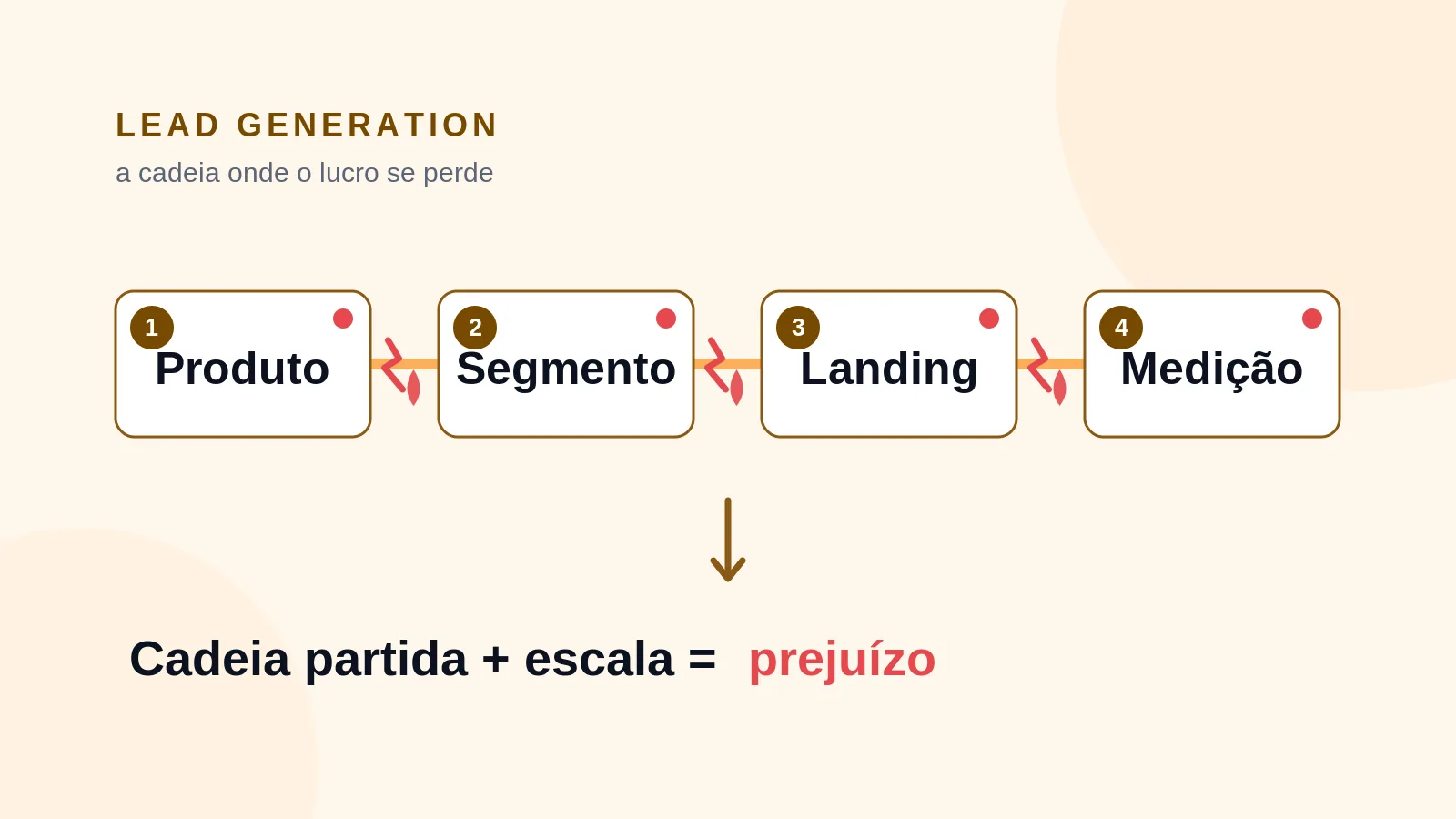
The lead generation chain: four points where profit leaks
- 1Product: amplifying a weak product just makes garbage faster
- 2Cheap segment: thin margin, high churn, zero tolerance for friction
- 3Landing: without a page of your own, conversion happens where you can't see
- 4Measurement: without linking click, lead and deal, you report faith
A broken chain plus scale equals loss, not profit.
I turn down nine out of ten brands that come to me for lead generation. It's not a full calendar or the pose of a difficult consultant: in most cases, there's no way to measure or control what happens to the lead once I've generated it. And generating demand on top of a process I don't control means signing off on a result that isn't mine.
Lead generation has a reputation as a lever. You put budget in one side, contacts come out the other, and it looks like growth. What nobody tells you upfront is that the machine doesn't tell a good deal from a bad one: it amplifies whatever is there. Before we talk channels, creative or CPL, there are four mistakes that decide whether this turns a profit or a loss. None of them is in the ad.
Lead generation for a bad product just makes garbage faster
Lead generation doesn't fix a weak product, a badly built offer or a price that's out of the market. It amplifies. If what sits behind the lead doesn't solve the buyer's problem, scaling only brings more people, faster, to the same disappointment, and burns the budget on the way.
The trap is that the acquisition machine looks like it's working. Leads come in, cost per lead even drops in the first weeks. Except downstream the close rate is low, returns are high and the customer doesn't come back. The channel isn't broken: it's doing exactly what you asked, which is take more people to an offer that can't stand scrutiny.
The pattern I see most is this: a brand with a demand or product problem trying to fix it with media budget. It doesn't fix it. It postpones it, with interest.
There's always a segment that pays little for a worse product
There's almost always a pocket willing to buy a worse version cheap. It's real and it's tempting, because it delivers quick volume and a cost per lead that looks good in the report. But it's a segment with thin margin, high churn and zero tolerance for friction. Building lead generation on top of it looks like scale and is, in practice, scaling work that never turns a profit.
Cheap leads aren't qualified leads. They're two different metrics and a lot of people treat them as one. Cost per lead lives at the top; what decides whether the business exists lives at the bottom, in close rate, average ticket and LTV. Optimising the top without looking at the bottom is tuning the speed without looking at the direction.
The right question is never what the lead costs. It's what the customer this lead becomes is worth, and with what probability.
If you only get paid per lead and don't control the chain, you're stuck
In a pay-per-lead model, whoever generates carries the risk and the advertiser keeps the upside. If you don't control qualification, the CRM, the follow-up and the close, you're judged on a number that depends on people you don't manage. It's the worst seat in the chain: accountable for the result, with no hand on the process that produces it.
The incentive is all crooked. You care about lead volume; the advertiser cares about leads that close. When their sales team disqualifies half on criteria that change on a Friday, the bill is yours. No creative makes up for not controlling what happens after the form.
Controlling the chain has a technical name, and it is where you see who is locked out. With enhanced conversions for leads, the form data is normalised and hashed in SHA256, and in Google's words "the provided hashed information is used to attribute back to the Google Ad campaign": you tie each lead to the click that produced it. With offline conversion imports, you upload the qualified lead and the closed sale back, and Smart Bidding starts bidding for quality, not the form fill. If you are paid per lead and have no access to that closing data, you are not just uncomfortable: you are outside the one mechanism that would optimise what matters. The loop exists. You just cannot reach it.
Without your own site or landing, the lead converts in the wrong place
If the conversion happens on the advertiser's site or a third-party platform, you can't see what fails, you can't run tests and you can't optimise. The lead converts where you have no control. You go blind at exactly the point where the campaign is won or lost.
A landing of your own isn't a control freak's whim. It's where you measure form friction, test the promise, install tracking properly and isolate the variable that matters. When that step lives on the other side, any diagnosis of yours becomes an educated guess: you know something drops between the click and the lead, but not what or why.
Whoever doesn't control the landing doesn't control the conversion. And whoever doesn't control the conversion isn't managing a campaign: they're rooting for it.
A contract with an exit, before the loss starts
Before I take it on, I write into the contract how success is measured, what access I have to the data and on what terms I leave. If I can't measure, I leave. An exit defined cold costs one uncomfortable conversation at the start; defined hot, in the middle of the loss, it costs the relationship and the money.
Three things go in writing before starting: which KPI defines success and who calculates it, what access I have to the advertiser's CRM and analytics, and the trigger that ends the engagement without penalty. It's not distrust. It's making clear, while everyone's optimistic, what happens when the numbers don't show up.
The time to negotiate the exit is before you need it. After that, it's no longer a negotiation: it's damage.
Lead generation without measurement has no conversions - it has faith
Without end-to-end measurement you don't have conversions. You have faith. And faith is good for a lot of things, just not for closing a report. If you can't link the click to the lead, the lead to the deal and the deal to the margin, you're reporting activity, not results.
The classic scene is lead ads dumping contacts into a spreadsheet nobody reads, with no handoff to the CRM and no quality signal back for the platform to optimise on. On top of that sits a truth few admit: part of the numbers you see is no longer measured, it is estimated. When a user declines cookies, Google concedes that "advertisers experience a gap in their measurement" and fills it with modeled conversions, which appear "in the same Google Ads reports as observed conversions", with no distinction. And it warns: "some conversions that in reality occurred may not be accounted for". The honest operator knows which part of the report is observed and which is modeled. Whoever cannot tell them apart reports a subset and calls it the truth.
With the measurement chain disconnected, GEO, attribution and optimisation are all the same thing: faith with a dashboard. With measurement, it becomes management. Without it, you're flying on instruments you never switched on.
Verdict: control the chain, or you scale loss instead of profit
Before scaling, answer four questions: do you control the product, the segment, the landing and the measurement? If you control three out of four, negotiate the fourth before moving. If you control none, what you'll scale is the loss, and you'll scale it with remarkable efficiency.
These aren't execution mistakes. They're mistakes of the foundation: no ad makes up for them. Lead generation is the last piece to switch on, not the first. Whoever switches it on first buys the illusion of growth at the price of real growth. It's the worst of both worlds: the invoice of someone who's growing and the results of someone who isn't.
That's why I turn down nine out of ten. Not because I can't do it. Because I know what it costs to do it on a base I don't control, and that cost is always the client's.
Sources
- Google Ads - About consent mode modeling
- Google Ads - Enhanced conversions for leads
- Google Ads - Offline conversion imports
Frequently asked questions
Is it worth paying per lead (CPL) instead of per sale?
Only when you have visibility over the whole funnel or a written, auditable definition of a qualified lead. Without that, you pay for volume and are judged on the close: you carry the risk without controlling the variable. See lead generation →
How do I know if a cheap segment is worth it?
By the economics downstream, not the CPL. Look at close rate, average ticket and LTV for that segment. A low cost per lead with a customer who doesn't come back is loss dressed up as efficiency. See Analytics consulting →
Do I really need my own landing?
To manage it seriously, yes. It's where you measure friction, run tests, install tracking and isolate what fails between the click and the lead. Without it, the conversion happens where you can't see it or optimise it. See Google Search Ads →