Europe just lost free product listings on Google - and rushing to a CSS solves the wrong problem
 By Miguel Maio ·

Between 17 and 18 September 2026, days before the DMA deadline on the 21st, Google removed free product listings and the "popular products" carousel in the EEA, with 90-100% drops in markets like Germany, France, Belgium, Sweden and the Netherlands. The space moved to an aggregator unit built on paid comparison shopping services (CSS). For European retail, this turns a free channel into an intermediated one - and the right response isn't to rush to a CSS, it's to strengthen the one anchor nobody intermediates: your own organic and first-party.
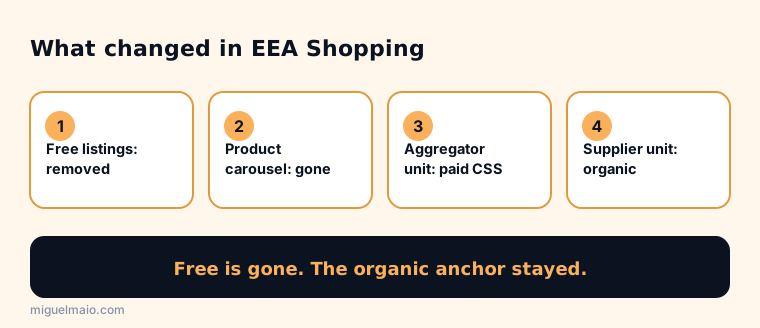
Google has ended free product listings across the European Economic Area. It wasn't a UI tweak: it was the conversion of a free channel into an intermediated one. Anyone running e-commerce in Europe woke up without a traffic source that cost nothing - and the first reaction, rushing to a paid comparison shopping service, solves the wrong problem.
What Google removed, and when
Between 17 and 18 September 2026, in a 48-hour window and days before the Digital Markets Act compliance deadline on 21 September, Google removed two formats in the EEA: free product listings (the merchant placements that cost nothing) and the "popular products" carousel that showed on commercial queries. Independent trackers logged 90-100% drops in five markets with sufficient data - Germany, France, Belgium, Sweden and the Netherlands. Ginny Marvin, Google Ads Liaison, confirmed the removal is down to the DMA.
The space didn't go empty. Since 8 September, EEA search has two new units: an aggregator unit, showing comparison services - shopping, travel, flights - and a supplier unit, giving retailers and other businesses a direct placement, with no extra feed, just normal crawling and the algorithm's ranking. Google's own Nick Fox called this "the largest reduction in quality of service in Search's 29-year history". It's rare for Google to describe one of its own changes in those terms - and it's the tell that it didn't make this one willingly.
Why it's worse than a format disappearing
Because it changes the nature of the channel, not just its look. The free listing had no intermediary: a merchant with a decent feed showed up without paying and without a margin going to anyone. What replaces it - the aggregator unit - runs on comparison shopping services (CSS), which are paid and take a margin. It's no historical accident: CSS were born from the 2017 antitrust remedy against Google Shopping, and the DMA has just made them the mandatory front door. What was an organic channel became a tolled one.
For a European retailer, the options come down to three, and none equals what was removed: buy Shopping ads, go in through a CSS that takes a margin, or leave the channel. Free listings cost zero and had no intermediary; each of the three alternatives costs money, margin, or visibility.
Who loses, and Europe's competitive disadvantage
The small retailer loses most. The free listing was the ramp that put a merchant with no budget inside a unit once reserved for advertisers. Without it, Shopping visibility now depends on paid budget or a CSS intermediary - which pushes the advantage to those with budget and to the big platforms.
And there's a layer almost nobody is naming: the competitive disadvantage of the European market itself. The DMA applies to what EEA users see, so e-commerce selling to European customers now operates in a pay-to-play market, while competitors selling to markets outside the EEA keep their organic Shopping presence. The result is a structural extra margin in any European retailer's funnel - a toll rivals in other markets don't pay. The irony is familiar: a rule designed to increase competition in Europe ends up making acquisition more expensive for those who operate in Europe.
Real alternatives for European retailers
There are five paths, and the mistake is to pick only one - or to pick the most expensive by reflex. In the order I usually recommend evaluating them:
- Supplier unit and organic results: this is what remains organic and pays no rent. It needs no feed - it needs technical SEO, product structured data, and category and product pages the algorithm can read and rank. The channel changed hands, but the algorithm still decides, and that can be worked.
- CSS, eyes open: a pragmatic option to recover the Shopping placement, often at a lower effective CPC than buying direct. But it's rent: you depend on an intermediary that takes a margin. Use it as a bridge, not a foundation.
- Marketplaces: immediate reach (Amazon and the like), but at the cost of margin and with no first-party data relationship. They diversify, they don't replace your channel.
- First-party - email, CRM, community: the traffic nobody can remove because it doesn't go through Google. The least glamorous and the most defensible.
- AI surfaces: generative Shopping (ChatGPT, and agentic commerce) and Copilot are starting to mediate buying decisions. It's early, but it's where the next round of visibility is decided - and it ties into commerce in ChatGPT and GEO.
The qualified-traffic anchor that remains
My advice to a European retailer today is not to let panic set the budget. Rushing to a CSS fixes the placement, but it trades one dependency for another. The anchor that remains - the only one no decision by Google or Brussels can take from you - is the combination of your own organic and first-party: product and category pages with solid structured data, a clear brand entity, and an email and CRM base that brings the customer in with no auction in between. That organic is what feeds the normal results and the new supplier unit, and that owned base is what lowers the cost of everything else. CSS and paid sit on top of this, not in its place.
Treat the DMA as a media-buying emergency and you'll pay the toll and stay exposed to the next rule change. Treat it as the final push to build acquisition that doesn't depend on a single gatekeeper and you come out stronger. Free listings are over; the dependency on them is what shouldn't have existed.
Key data
| What was removed | Free listings + carousel |
|---|---|
| When | 17-18 Sep 2026 (DMA: 21 Sep) |
| Markets with 90-100% drop | DE, FR, BE, SE, NL |
| What fills the space | Aggregator (CSS, paid) |
| What stays organic | Normal results + supplier unit |
Percentages from independent trackers; vary by market and method. What "stays organic" is still settling.
Sources: Search Engine Roundtable · PPC Land · Search Engine Journal
Sources
- Search Engine Roundtable - Google Drops Free Product Listings From EEA
- PPC Land - Google drops free shopping listings across Europe in two days
- Search Engine Journal - Google Rolls Out Redesigned Search Results Across The EEA
Frequently asked questions
Does this affect my e-commerce if I'm not based in Europe?
It affects what EEA users see. If you sell to customers in the European Economic Area, you lose the free placement in that market, wherever you're based. Outside the EEA, organic Shopping remains for now. Commerce in ChatGPT →
Should I join a CSS right away?
It's a legitimate option to recover the Shopping placement, often cheaper than buying direct - but it's rent to an intermediary. First strengthen the organic and first-party anchor; the CSS comes in as a bridge, not a foundation.
Does the supplier unit need a product feed?
No. Per Google, the supplier unit uses normal crawling and the algorithm's ranking, with no extra feed. So technical SEO and product structured data are again what decides your visibility. Structured data →